

Winner 2026 River Heron Poetry Prize
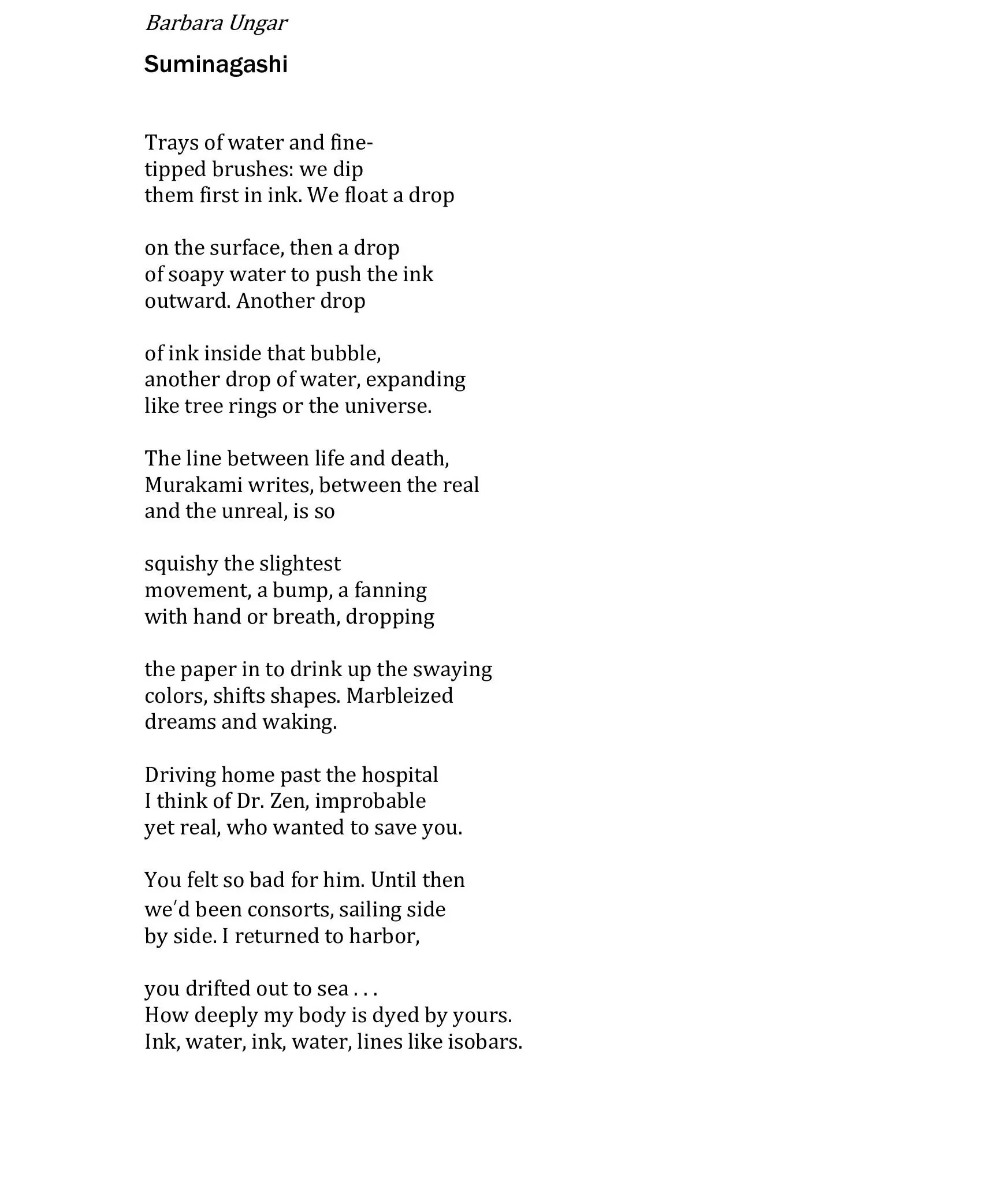
Suminagashi (“ink floating”) is a traditional Japanese paper marbling technique. The poem comes from the manuscript Waiting for Your Ghost, addressed to the late Stuart Bartow, my consort and first reader for two decades. I was reading Haruki Murakami’s The City and Its Uncertain Walls, which features a ghost. The penultimate line is from a tanka by Izumi Shikibu: "In this world / love has no color—/ yet how deeply / my body / is stained by yours.”
Barbara Ungar has published six books of poetry, most recently After Naming the Animals. Her fourth chapbook, Heavenly Blue, won the Rattle chapbook prize, and will be forthcoming in December. Prior honors include the Snyder Prize from Ashland Poetry Press, the Gival Poetry Prize, and being named to Kirkus Reviews’ Best Indie Books of 2015 and 2019. She has published poems in Scientific American, Southern Indiana Review, Pedestal, and many other journals. Her work has been translated into Spanish, Italian, Portuguese, and Bulgarian. Professor emerita from the College of Saint Rose, she lives in Saratoga Springs, New York.
W: www.barbaraungar.net
I: @barbara_l_ungar
F: Barbara Ungar

Photo by Joanne Ungar
Judge Alison Tanik’s Comments:
Written in tercets, the poet has made stylistic choices which reflect, as much as possible, a circle, a loop. While the couplet can be seen as a standard form for romance, depicting two people, and a quatrain has a finite quality to it, the tercet is an excellent form for suggesting continuity as it spills from one stanza to the next. It could be representing the continuum of a diameter, or the outline of an ellipse, or the permanence of a strong relationship, or the floating shapes of Suminagashi. The repetition of words: 'water', drop', 'ink' also creates the idea of continuity/infinity, of 'tree rings or the universe'. This mesmerising drawing of concentric circles linguistically and stylistically, make the poets confession that 'Until then we'd been consorts, sailing side by side' perhaps the most striking part of the poem. The line leaves me in two minds at once: is it only the poet who has not noticed that their relationship is a series of interlocking hoops rather than parallel lines? Or does the strength in their relationship lie in the fact that they are both very traditionally side-by-side and yet also drops of water and ink one inside the other, each holding the other, spreading inseparably across time, 'like isobars'?
Quisque iaculis facilisis lacinia. Mauris euismod pellentesque tellus sit amet mollis.