
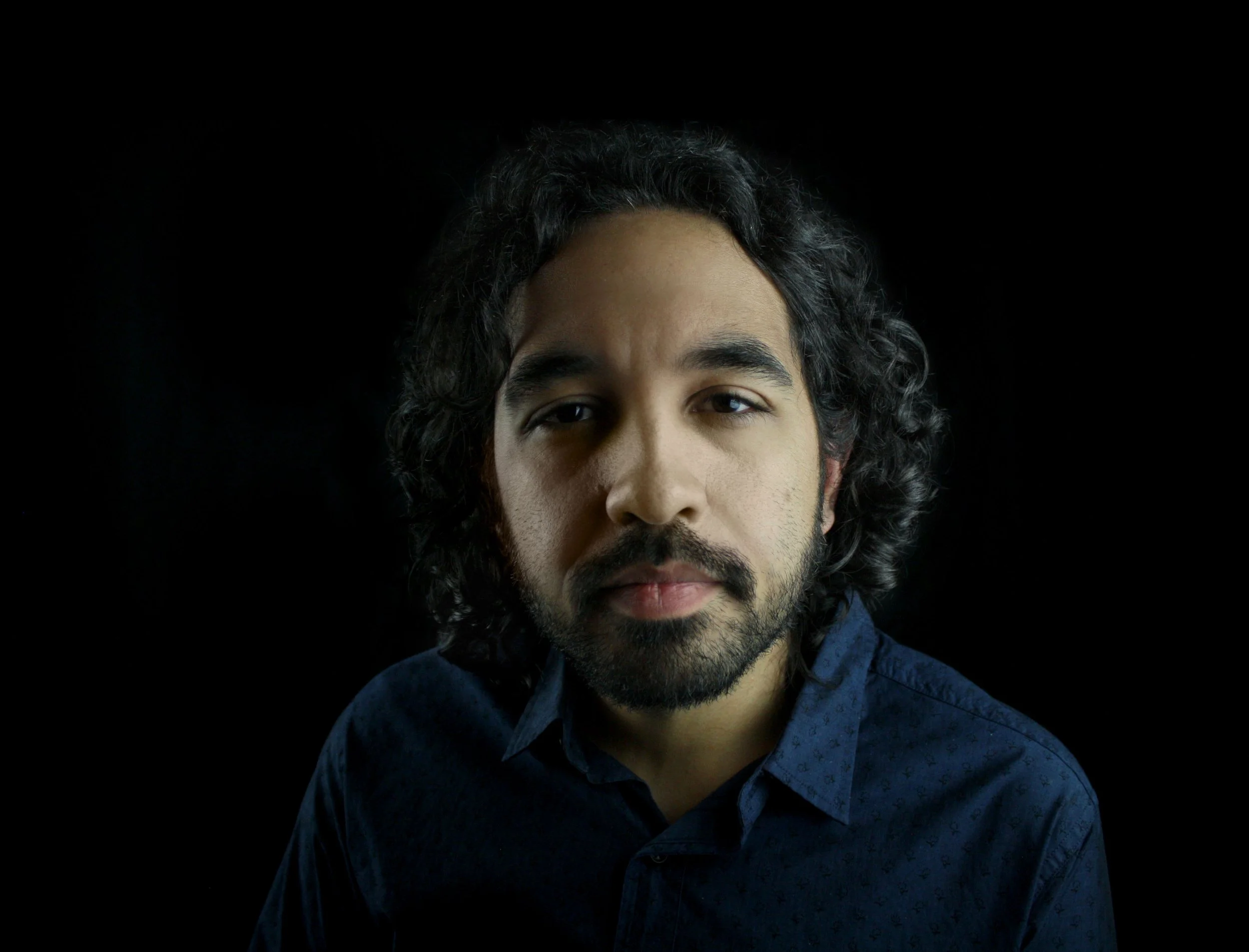
Keith S. Wilson is a poet, game designer, and multimedia artist. He is an Affrilachian Poet, a Cave Canem fellow, and a recipient of an NEA Fellowship, a Kenyon Review Fellowship, and a Stegner Fellowship. Additionally, he has received fellowships or grants from Bread Loaf, Tin House, and the MacDowell Colony. His first book, Fieldnotes on Ordinary Love (Copper Canyon, 2019), was recognized by the New York Times as a best new book of poetry. His second book, Games for Children (Milkweed Editions, 2025), was a winner of the National Poetry Series.
I recently had the pleasure of chatting with Keith S. Wilson about his latest book, Games for Children, a dynamic and engaging collection that moves language in startling and multi-faceted ways, including through visual poems. I recommend you check it out—you can purchase the book from Milkweed Editions.
Meghan Elizabeth Kelley: I thought we’d start off with the visual poems in this book and your visual work in general. Stylistically, your work as a visual poet feels distinct, and I’ve heard you characterize it as “rhetorical.” Can you describe how you think about your visual work?
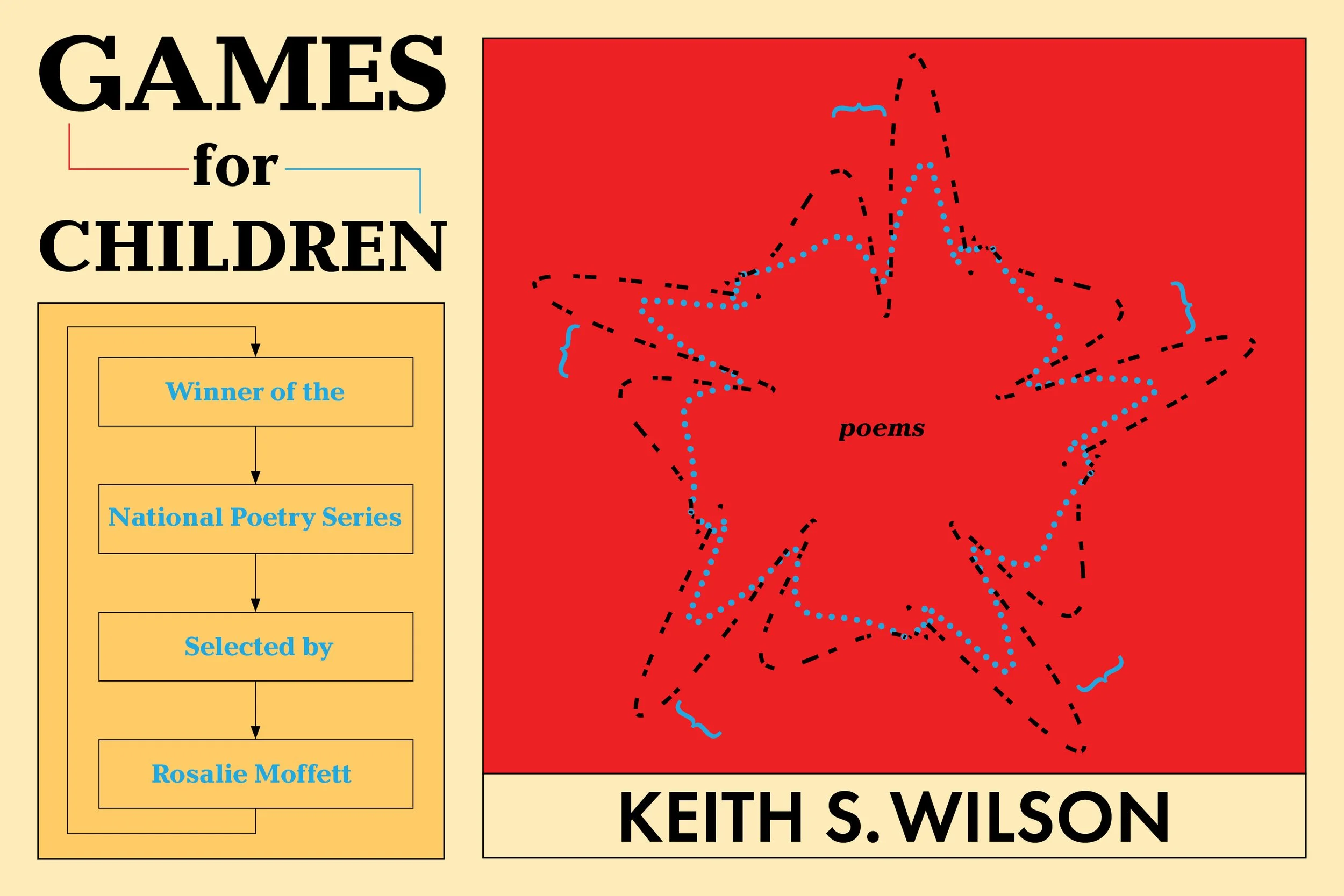
Keith S. Wilson: I don’t actually think of my work as satire or parody (for one thing, I’m not usually overtly being funny), but in a strange way, I think it works similarly. A good parody can work fully on its own, but it is also, all the time, working at a level that includes the conventions, expectations, and history of that genre. And both parody and satire are rhetorical—they criticize some aspect of the form while also expressing great love for it.
So for example, if you’d never seen a horror movie before, you could follow the plot and be engaged with it, but the more you understand the genre, the more you’ll notice about the movie through the nature of its form. In my case, the “genre” I’m writing in is everything from graphs and infographics to scientific concepts like the electromagnetic spectrum.
MEK: Given that framing, I’m wondering if there’s a specific way you hope readers engage with your visual work, especially readers who might feel unsure about or challenged by visual poetry.
KSW: I work toward giving readers multiple ways into my poetry, but a challenge is that poetry has a history of being taught or understood as a sort of puzzle. In school, we’re often asked questions about poems as if they have a singular, specific answer, especially because we are taught poetry as a part of history. Of course, it IS a part of history, and there ARE some answers about why a poem was written, what it was a response to, what it is referencing, and so on.
But I think this can drown some readers in the “hidden facts” of a poem and cause them to think their own understanding of a poem is wrong because it was not on the list of answers. And even worse, some readers learn to suppress the most human urges of wonder and speculation, and the moment they become lost in a poem, they move on to one they think they can figure out.
My intention is that the reader pick up what they pick up. I included a notes section in the book for the curious, but I also work many layers into anything I write. So you might not know much about pie charts, but you might notice the one I use in the book looks like Pac-Man. I think that’s a valid way to engage with poetry—to let it speak to you at the place where you’re at.
MEK: Something that I also love about this book is how it physically engages the reader. As one example, “Bonus Activity” can be physically cut out and laid over the William Carlos Williams’ poem “This Is Just to Say” to make a new poem. When you were writing this book, were you thinking about the tactile experience of the reader?
KSW: Yes! Thank you for pointing that out—I haven’t been asked about that before. Many of the poems exist in totally different (extra?) forms outside of the book. I actually designed a half a dozen versions of that poem that exactly cover portions of “This Is Just to Say” for each version of The Norton Anthology of Poetry I could get my hands on. One day, maybe, I’ll release them. I also made a version of my poem “Line Dance for an American Text Book” that is printed on acetate and lets the reader flip through it.
One happy surprise is that Milkweed decided that the best way to print these poems was in a horizontal orientation. The book is the typical poetry book size, but turned on its side, and I think that lets the reader experience poetry in a new way as well. I’m very interested in including the reader. Often, it can seem like the only decision a reader can make with a poem is whether to read it in their head or aloud, but if you consider how powerful it can be to hear a poem in your own voice, you can begin to understand the potential of poetry as an embodied form—as something you can “do.”
MEK: I think that attention to embodiment is characteristic of your work. I sensed that in your first book, Fieldnotes on Ordinary Love, which, interestingly, consists of entirely traditionally lineated poems. But this book moves seamlessly between traditional poems like “there aren’t enough idioms about the stars” and visual poems like “spell to trace a rainbow to its apogee.” Can you describe your thought process around form in this collection?
KSW: A question I asked myself for every visual poem was: What is the visual doing for this poem? Or put another way: Is this poem “better” for being visual? When the answer to that was “no,” I did not force the poem to be visual.
I think there’s something satisfying or elegant about a totally unified art object—the “project” book—but I also think that the poetry you write begins to form its own personality. Maybe that’s what prose writers mean when they talk about a character that they’ve created speaking to them.
I have a poem called “Field Switch” in this book that uses the electrical diagram of a simple light and switch. But I was also interested in how a “switch” is a form of corporal punishment, especially for children. So when the visual form speaks with the poetic one, I let the conversation happen. And when I am trying to force it, I try to let it fall away.
MEK: Your work consistently has an incredible sense of capaciousness and wonder while simultaneously holding past and present violences, particularly with respect to race and gender. How do you think about poems as containers to hold both violence and wonder?
KSW: Brian Sutton-Smith has a book called The Folkstories of Children that is a compilation of interviews with children over the years. Starting at the age of two, he has them tell stories over many years, so it’s this study of the development of language, storytelling, and of a general sort of comprehension of the world. One of the things that is striking to me is that if you were to take a two-year-old’s “story,” it’s often just a series of provocative words—it reads like poetry. I think humans are containers of violence and wonder, and poems, like children, are reflections of us at our best and our worst.
MEK: In this book, there’s a series of poems that use the concept of the uncanny valley in relation to processing Emmett Till’s murder, where the poems visually repeat but also transform as the book progresses. You also revisit the poem “I Find Myself Defending Pigeons” from your first book and add a new visual layer to it in this book. I’m curious if you can share more about multiplicity and transformation in your work.
KSW: Toni Morrison has this concept she talks about in Beloved called “rememory” that is about how the past isn’t just a set of thoughts we have about what came before us, but it is also often an actual physical force. It’s a haunting. But to mix metaphors, I think you never step into the same haunting twice. Violence accumulates, and the nature of it changes by accumulation. But also, we change, so that even things like love become altered by the lives we’ve led and the people who change us.
My poem “I Find Myself Defending Pigeons” is about a speculative, radical love where we find room to love others even when they are absolutely nothing like us. When I returned to it in this book, I was thinking about how that love I projected out into the world is, upon reflection, fragile as glass.
And likewise, those Emmett Till poems were me reckoning with how violence changes us as a nation, or as human beings. We are transformed by it, but maybe no transformation is ever final. We find new reasons to wake up in the morning, or new ways to be thankful for what we woke up for yesterday. Can I capture that in a poem? I don’t know. I keep trying.
MEK: Keith, it’s been a pleasure to chat with you. Thanks so much for sharing these generous thoughts about your work and your process.
To follow or connect further with Keith:
Instagram: @keithing_it_real
X: @keithwilsonpoet
Bluesky: @keithwilsonpoet.bsky.social

Meghan Elizabeth Kelley is a writer and poet from the Philadelphia, PA area. Her work has appeared in Epiphany, Bellingham Review, HAD, Frozen Sea, and Toyon: Multilingual Literary Magazine, among other places. She has an MFA from Randolph College.



Quisque iaculis facilisis lacinia. Mauris euismod pellentesque tellus sit amet mollis.